
.jpg)
History and Culture
Aunque se sugiere como de origen Haitian, chenchén is a very distinctive dish that stands out because it is made with cracked corn and is served with stewed beans and meat, usually goat, sometimes with cassava bread. It is commonly found in border towns and in some inland communities of the country, where it is proudly showcased. That is where its local and regional heritage value lies.
Grains, as a dietary tradition, are closely linked to Afro-American cultures. In Africa they are staple foods, and their production and consumption help people cope with scarcity. In our Afro-American societies, not all grains are of African origin; some come from Europe, such as lentils. Corn, on the other hand, is American, as are beans, while goat was introduced by Europeans. However, the combination of these ingredients, as with sancocho, results in a quintessentially creole dish.
Therefore, it is difficult to place chenchén neatly into a single cultural category or to determine its exact origin. Even the word itself has been linked to Haitian Creole, which does not necessarily imply an African origin. Corn, being an inexpensive food, makes it possible to create an accessible dish. It is worth remembering that many icons of Latin American cuisine emerged from the economic limitations of those who created them and later became popular as traditional dishes.
It is clear that chenchén is associated with San Juan de la Maguana, although it is also eaten in other places, where it is often perceived as something exotic. The greatest difficulty in preparing it does not lie in the corn itself, but in two factors: the goat, due to its scarcity and limited large-scale production, and the precise cooking point of the cracked corn. It must soften without breaking down into a paste or remaining hard, since its texture and flavor determine the balance of the dish. The other ingredients are secondary to the corn preparation, the true heart of chenchén.
Although I have conducted fieldwork in bateyes in the south, north, and east of the country, I have rarely observed chenchén in these communities, which are mostly inhabited by Haitians, Dominican-Haitians, and Dominicans integrated into what is known as batey culture. However, in the south, especially in San Juan de la Maguana, it appears strongly tied to popular religious festivities, funerals, and even large celebrations that end with chenchén. For the people of San Juan, it is a source of pride to be associated with this dish because of its preparation, flavor, and frequency. It is part of the menu in traditional restaurants and is also a recurring meal even outside of festivals and ceremonies.
It is prepared with cracked corn or with corn flour, available in local popular markets. It is served with stewed red beans, part of the Dominican “bandera,” and stewed goat, creating a combination of flavors that is uncommon among Dominican traditional dishes. This is what gives it its particular character and identity.
The way it is served is also interesting: the ingredients are mixed directly on the plate, unlike the Dominican “bandera” (rice, beans, and meat), which are presented separately so each person can combine them as they wish. This serving style stands out in its promotion, because it appears as a single integrated and colorful dish: the slightly yellow corn, the reddish-brown beans, and the goat in reddish tones.
Depending on the occasion, it may be served on a regular plate or in a higüero (calabash bowl), especially in popular religious celebrations.
In San Juan de la Maguana, it appears at festive dinners, Vodou ceremonies, sports or political celebrations, everyday meals, funeral rites such as the Nine Days, and Liborista ceremonies or brotherhoods devoted to Saint John the Baptist or the Holy Spirit. It is also sold in food stalls and eateries as part of their regular offerings, which is not the case in other towns, where it often must be ordered in advance.
In terms of its symbolic, ritual, and identity value, chenchén can be considered a substitute for sancocho without competing with it. Because of its importance, demand, recurrence, and ritual role in San Juan de la Maguana, this dish becomes a culinary jewel that its people preserve with pride as an essential part of their cultural identity.

Vegetable stock
1 L
Can be substituted with water.

Golden onion
1/2 unit
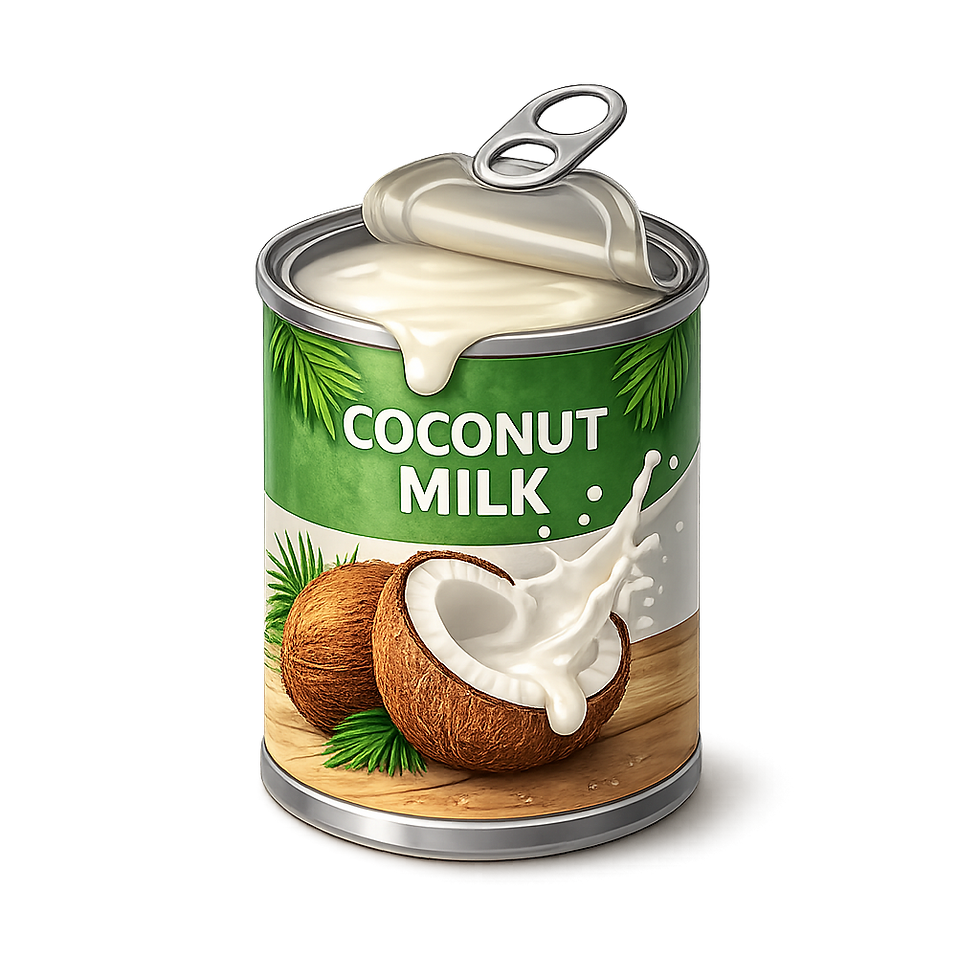
Coconut milk
360 ml

Cocoa corn
1 lb
Crushed corn.

Cubanelle chili
1 unit

Cilantro
1 sprig.

Evaporated milk
360 ml
Whole milk
4 cups.

White sugar
28 g

Salt
-
-

Butter
2 tbsp.

Garlic
2 cloves.
Ingredients
Recipe and Preparation
PREPARATION
Gather all the ingredients and utensils you will use.
Peel and mash the garlic.
Finely chop the cilantro.
Cut the onion and the bell pepper into brunoise (very small cubes).
SOAK AND WASH THE CORN
Place the corn in a container and cover it completely with water.
Let it soak for at least 2 hours.
Wash the corn to remove any loose husks and excess starch.
Drain well and set aside.
MAKE THE CHENCHÉN
Preheat the oven to 180 °C (356 °F).
In a skillet, melt the butter over medium heat, making sure it does not burn.
Sauté the corn with the vegetables (garlic, onion, bell pepper, and cilantro) for about 2 minutes, stirring constantly.
Add the vegetable stock and cook uncovered over medium heat until the liquid has completely evaporated. Stir frequently so it does not stick.
Once the corn is tender, add the milks and cook over low heat, stirring continuously, for 15 to 20 minutes.
Let the mixture dry slightly, then transfer it to the oven at 180 °C (356 °F) until it develops an appetizing golden color.
Where to eat this dish

AVOCADO Restaurant
Category
Lemon Time
Category
Pasteles La Abuela
Category
Pasteles La Abuela
Category
No establishments to show at the moment.
Comments
There are no comments yet...
-