
_edited.jpg)
History and Culture
Rice cultivation began nearly 10,000 years ago in various humid regions of tropical and subtropical Asia. This cereal is the staple food for more than half of the world’s population. It ranks second after wheat in harvested area and provides more calories per hectare than any other cultivated cereal.
According to the article Origen, Evolución y Diversidad del Arroz, by researchers Marco A. Acevedo, Willian A. Castrillo, and Uira C. Belmonte from the Centro de Investigaciones Agrícolas de Guárico (Venezuela) and the Department of Genetics at the University of São Paulo (Brazil), the routes of rice dispersal around the world began in Southeast Asia, specifically in India, from where it spread to China around 3000 B.C. It later expanded to Korea and Japan in the 1st century B.C. From India it was also taken to the islands of the Indian Ocean, mainly Indonesia and Sri Lanka, during the same period.
In general, domesticated crops in East Asia spread westward in relatively recent times. Arab merchants were the first to introduce rice from East Asia into the Middle East, around the 9th century B.C. At the same time, the cereal reached Egypt and other African countries. The introduction of rice into the West occurred approximately around 320 B.C., while in the Americas it took place in the post-Columbian era, brought by Spanish, Portuguese, and Dutch colonizers.
Rice planting in the Dominican Republic dates back to the time of the discovery, after Christopher Columbus’s second voyage, when the first cultivation experiments began with the founding of La Isabela. One of the first areas chosen for planting was located to the west of the Esperanza region. Later, in 1919, irrigated rice cultivation began thanks to the Belgian Flemish immigrant Louis Libert Bogaert, who, after carrying out topographic calculations of the Mao River, verified the existence of areas at a higher elevation than the riverbed, which made it possible to grow the cereal (Benitez, Osmar, 2019).
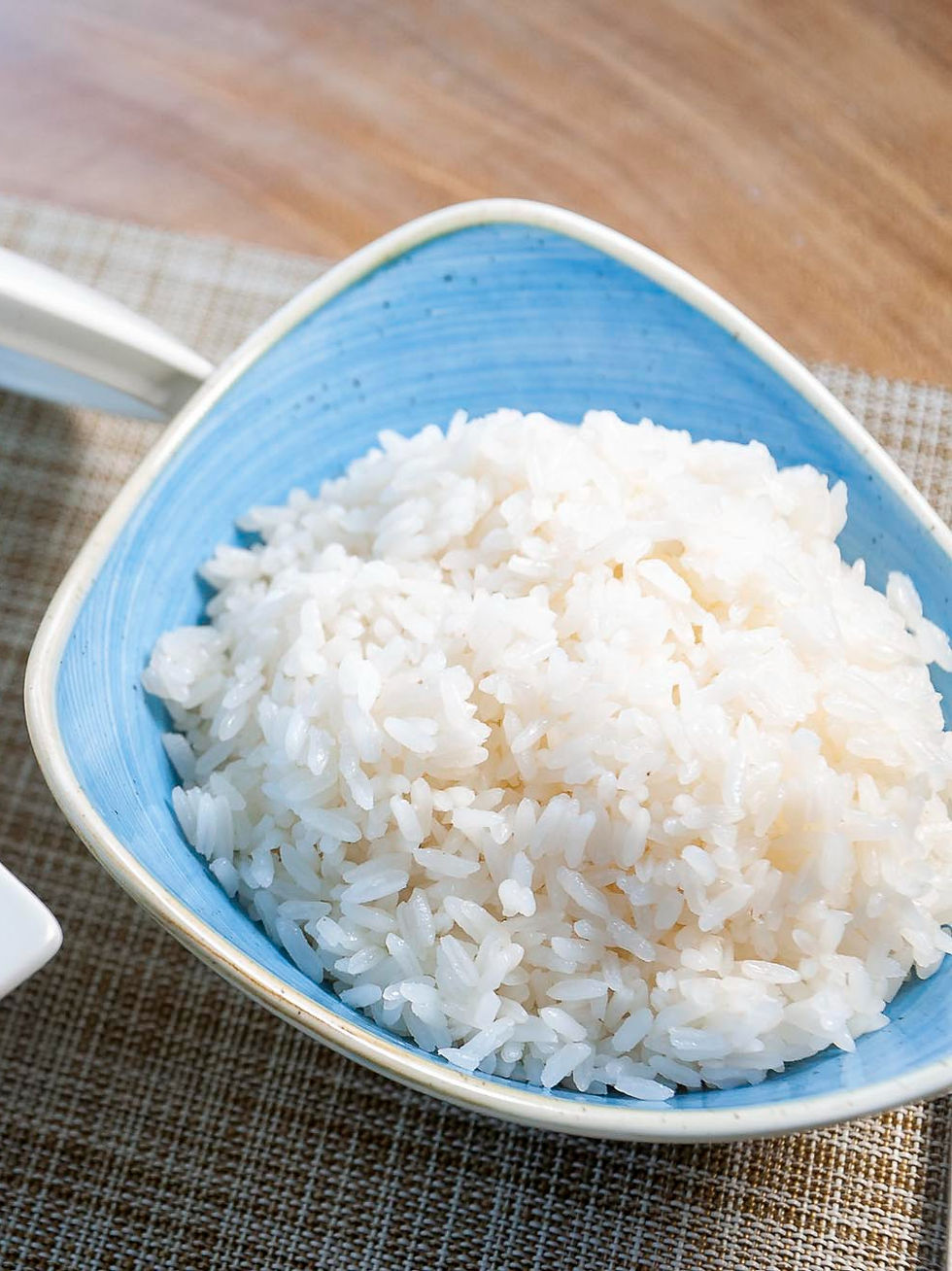
In Dominican gastronomy, white rice is a highly valued dish due to its versatility and practicality. For Dominicans, white rice “goes with everything.” Its importance is such that it is an essential part of what is known as the “Dominican gastronomic flag.”

Water
600 ml

Vegetable oil
45 ml
It can be soy, canola, peanut, corn, olive, etc.

Salt
-
-

Rice
1 lb
White, long grain.

Garlic
1 clove.
Optional.
Ingredients
Recipe and Preparation
PREPARATION
Gather all the ingredients and utensils.
Peel the garlic, remove the germ, and crush it; set aside.
Wash the rice, drain, and set aside.
RICE COOKING
In a medium caldero, heat half of the oil with the salt, add the garlic, and lightly saute.
Carefully add the water and bring to a boil over high heat (about 150°C).
Add the rice, let it return to a boil, and cook for 12 to 15 minutes, stirring regularly to prevent sticking.
When the water evaporates, cover and lower the heat to the minimum for 15 minutes.
Taste the rice; if it is not ready yet, cover and leave it for 5 more minutes.
Finally, transfer to another container and keep covered until serving, to prevent it from sticking to the concón.
Where to eat this dish

AVOCADO Restaurant
Category
Lemon Time
Category
Pasteles La Abuela
Category
Pasteles La Abuela
Category
No establishments to show at the moment.
Comments
There are no comments yet...
-